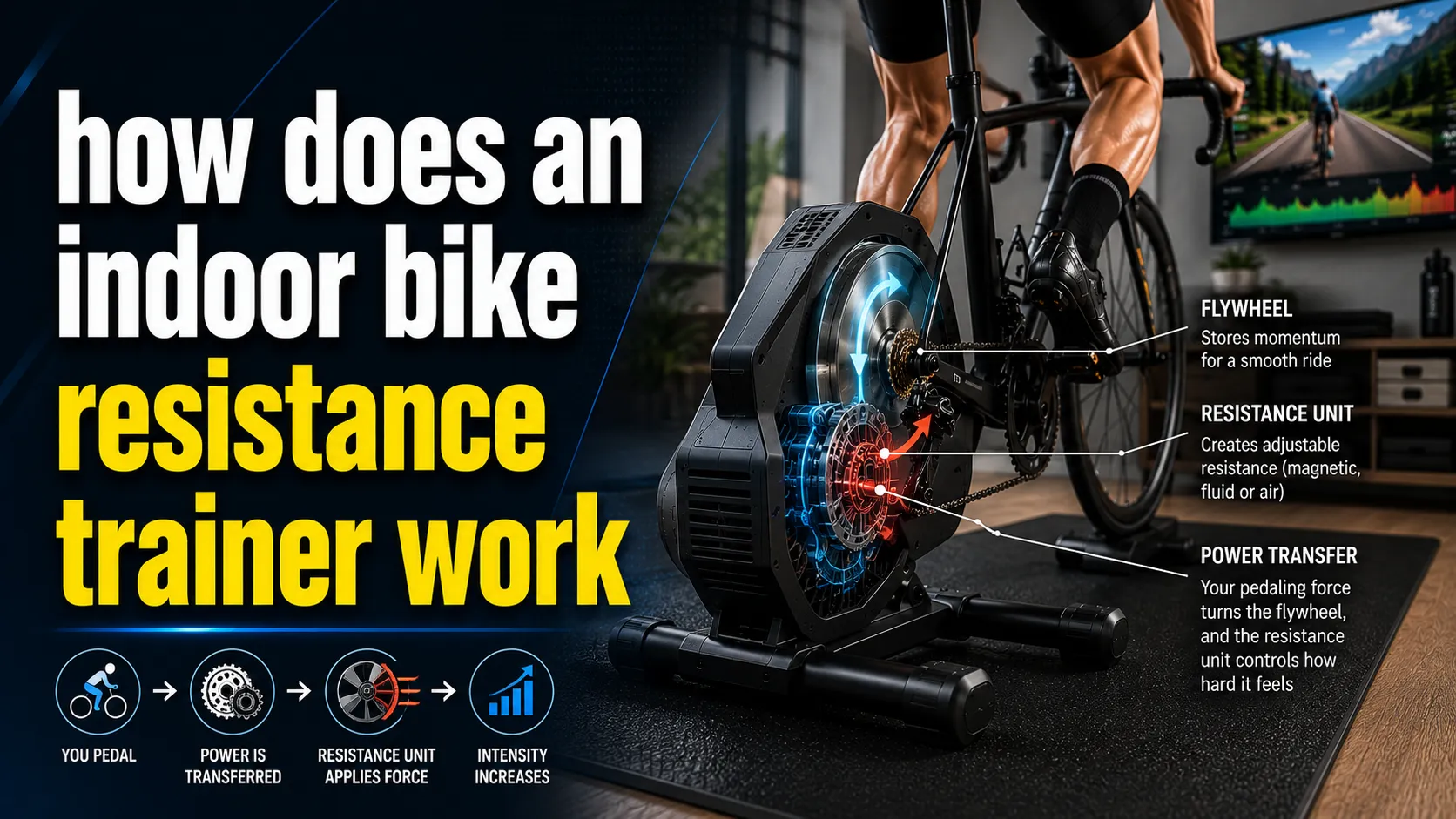
An indoor bike resistance trainer works by holding your bike in place while creating resistance against the rear wheel or drivetrain. This resistance makes pedaling harder, so you can ride indoors for fitness, winter training, warmups, or structured cycling workouts.
An indoor bike resistance trainer works by using magnetic, fluid, air, or electronic resistance to make pedaling feel harder. Wheel-on trainers press your rear tire against a roller. Direct-drive trainers replace the rear wheel and connect your bike directly to the trainer.
My Simple Take on Indoor Bike Resistance Trainers
I am Ryan Mitchel, and I write about cycling gear and active lifestyle products for ProKingsEdge.com.
An indoor bike resistance trainer is one of the easiest ways to ride your regular bike indoors.
You do not need a full exercise bike. You use your own bike, attach it to the trainer, and pedal in place.
The trainer adds resistance, so your workout feels like real cycling instead of just spinning the pedals freely.
The idea is simple. But the way resistance works can be different depending on the trainer type.
Safety note: No indoor bike trainer can fully prevent falls, injury, or equipment damage. Set up the trainer correctly, check bike compatibility, tighten all parts, and stop using damaged gear.
What Is an Indoor Bike Resistance Trainer?
An indoor bike resistance trainer is a stand that turns your outdoor bike into a stationary indoor bike.
It holds the bike upright and adds resistance while you pedal.
This lets you ride indoors when the weather is bad, roads are unsafe, or you want a controlled workout at home.
Indoor bike trainers are popular for winter cycling, apartment workouts, road bike training, warmups, and home fitness routines.
The trainer holds your bike steady and creates resistance against your pedaling force. The harder the resistance, the harder it feels to pedal.
Why Resistance Matters
Without resistance, indoor cycling would feel too easy.
You could spin the pedals fast, but your legs would not have much work to do.
Resistance gives your muscles something to push against.
That is what makes the trainer useful for fitness, endurance, strength, and structured cycling workouts.
For general cycling education and safety habits, the League of American Bicyclists shares helpful rider guidance.
The trainer is only one part of the ride feel. Your tire, bike setup, floor surface, and trainer mat can also affect noise and smoothness.
The Basic Parts of an Indoor Bike Trainer
Most indoor bike resistance trainers have a few main parts.
These parts work together to hold the bike and create resistance.
| Trainer Part | What It Does | Why It Matters |
|---|---|---|
| Frame | Holds the bike upright | Controls stability during riding |
| Resistance unit | Creates pedaling resistance | Makes the workout harder |
| Roller | Touches the rear tire on wheel-on trainers | Transfers tire movement into resistance |
| Axle mount | Locks the bike into place | Keeps the bike secure |
| Flywheel | Adds smooth motion | Improves ride feel |
| Adjustment knob | Controls tire pressure on wheel-on trainers | Affects grip, tire wear, and noise |
How a Wheel-On Indoor Bike Trainer Works
A wheel-on trainer is the simplest type.
You keep the rear wheel on your bike.
The trainer clamps onto the rear axle. Then the rear tire presses against a roller.
When you pedal, the tire spins the roller. The roller connects to the resistance unit.
That resistance unit makes pedaling harder.
The rear axle locks into the trainer frame.
The rear tire presses against the trainer roller.
As you pedal, the roller spins and the resistance unit makes pedaling harder.
How a Direct-Drive Bike Trainer Works
A direct-drive trainer works differently.
You remove the rear wheel from your bike.
Then you attach the bike directly to the trainer.
The trainer usually has a cassette, which is the group of gears your chain runs on.
When you pedal, your chain turns the trainer directly.
This setup usually feels smoother and quieter than a wheel-on trainer.
Direct-drive trainers often need cassette compatibility checks. Do not assume every trainer fits every bike without extra parts.
Wheel-On vs Direct-Drive Resistance
| Feature | Wheel-On Trainer | Direct-Drive Trainer |
|---|---|---|
| Bike setup | Rear wheel stays on | Rear wheel comes off |
| Resistance contact | Tire spins a roller | Chain drives the trainer |
| Noise | Usually louder | Usually quieter |
| Tire wear | Can wear rear tire | No rear tire wear |
| Ride feel | Basic to good | Smoother and more realistic |
| Price | Usually cheaper | Usually more expensive |
How Magnetic Resistance Works
A magnetic bike trainer uses magnets to create resistance.
As the roller or flywheel spins, magnets create force against the motion.
This makes pedaling harder.
Some magnetic trainers have a handlebar remote or resistance dial. You can use it to make the ride easier or harder.
Magnetic trainers are simple, affordable, and beginner-friendly.
The downside is that the ride feel may not feel as smooth as fluid or smart trainers.
How Fluid Resistance Works
A fluid bike trainer uses thick fluid inside the resistance unit.
As you pedal faster, the internal parts move through the fluid.
This creates more resistance.
The faster you pedal, the harder it usually gets.
This feels more natural than many basic magnetic trainers.
Fluid trainers are popular because they are smooth, simple, and good for regular indoor cycling.
How Air Resistance Works
An air resistance trainer uses a fan or air-based resistance unit.
As you pedal faster, the fan moves more air.
More air movement creates more resistance.
This system can feel natural, but it is often loud.
For apartment riders, air resistance trainers are usually not the best choice.
How Smart Trainer Resistance Works
A smart trainer uses electronic resistance control.
It can connect to cycling apps, sensors, phones, tablets, or computers.
The app can change resistance for hills, intervals, workouts, or virtual riding routes.
This makes smart trainers useful for structured training.
Some smart trainers also measure power. Power shows how hard you are working in watts.
USA Cycling provides resources for riders who want to learn more about structured cycling and training through USA Cycling.
Resistance Types Compared
| Resistance Type | How It Works | Best For |
|---|---|---|
| Magnetic | Magnets create resistance against movement | Beginners and budget riders |
| Fluid | Internal fluid creates smooth resistance | Regular indoor cycling |
| Air | A fan creates resistance as speed increases | Riders who do not mind noise |
| Smart electronic | Software controls resistance electronically | App-based workouts and serious training |
How the Trainer Makes Pedaling Harder
The trainer makes pedaling harder by resisting motion.
On a wheel-on trainer, your tire turns a roller.
The roller connects to a resistance unit.
That resistance unit pushes back against the spin.
On a direct-drive trainer, your chain turns the trainer directly.
The trainer creates resistance through the internal system.
The result is simple: your legs have to work harder to keep the bike moving.
Does an Indoor Bike Trainer Feel Like Riding Outside?
Some trainers feel more realistic than others.
Basic magnetic trainers can feel less natural.
Fluid trainers usually feel smoother.
Smart direct-drive trainers often feel closest to outdoor riding.
But no indoor trainer feels exactly like the road.
Outside, you deal with balance, wind, road surface, turns, traffic, and changing terrain.
Inside, the trainer controls most of the ride feel.
Best Fit by Rider Type
A basic magnetic wheel-on trainer is simple, affordable, and easy to understand.
A quiet fluid or direct-drive trainer with a mat is usually a better choice.
A smart direct-drive trainer gives better ride feel, app control, and training data.
Quick Indoor Trainer Pick Categories
These are not exact product names. They are trainer types to compare before buying.
A good balance of smooth resistance, fair noise level, and simple setup.
A practical starter choice for basic indoor cycling workouts.
A better option for app-based workouts, power data, and serious training.
What Affects Resistance Feel?
Resistance feel depends on more than the trainer type.
Your bike, tire, floor, mat, gearing, and setup can all change how the ride feels.
| Factor | How It Affects Ride Feel | Simple Fix |
|---|---|---|
| Tire pressure | Low pressure can feel soft or uneven | Inflate to the right range |
| Roller tension | Too loose can slip, too tight can wear tire | Adjust carefully |
| Trainer mat | Can reduce vibration | Use a proper bike trainer mat |
| Bike gears | Higher gears feel harder | Shift based on workout goal |
| Trainer type | Changes smoothness and resistance curve | Pick the type that matches your needs |
| Flywheel size | Can improve smoothness | Choose better trainers for smoother feel |
Why Some Trainers Are Loud
Noise is a common indoor trainer problem.
Wheel-on trainers can be loud because the rear tire spins against the roller.
Tread pattern matters too. A knobby mountain bike tire can be very loud on a trainer.
The floor can also make the sound worse.
Hard floors can transfer vibration into the room below.
If noise matters, use a trainer mat, keep your drivetrain clean, and avoid knobby tires on wheel-on trainers.
Common Indoor Trainer Noise Sources
| Noise Source | Why It Happens | What Helps |
|---|---|---|
| Rear tire | Tire rubs against roller | Use a slick trainer tire |
| Drivetrain | Chain and gears create sound | Clean and lubricate the chain |
| Floor vibration | Trainer vibration transfers through floor | Use a thick trainer mat |
| Fan resistance | Air trainers move air loudly | Choose fluid or direct-drive instead |
| Loose setup | Parts rattle or shift | Check mounts and bolts |
Does a Bike Trainer Damage Tires?
A wheel-on trainer can wear your rear tire faster.
This happens because the tire presses against the roller while you pedal.
A regular outdoor tire can heat up, wear down, or leave rubber dust.
A trainer tire can help. It is made for indoor trainer use.
Direct-drive trainers do not wear the rear tire because the rear wheel is removed.
If you use a wheel-on trainer often, a trainer tire is a smart upgrade. It can reduce tire wear and noise.
What Accessories Help an Indoor Bike Trainer Work Better?
A trainer mat protects your floor and helps with vibration.
A fan keeps you cooler because indoor cycling gets hot fast.
A towel protects your bike from sweat.
A tablet holder can help if you follow workouts or watch training videos.
Safety Warning Before Using a Bike Trainer
Always check that your bike is locked into the trainer before riding. A loose axle, unstable frame, or wrong adapter can cause falls or equipment damage.
The National Safety Council shares general bicycle safety information that can help riders understand basic cycling risks.
Common Mistakes With Indoor Bike Trainers
Using the Wrong Axle Setup
Some bikes need a special axle or adapter.
Do not force the bike into the trainer.
Pressing the Roller Too Hard
Too much roller pressure can wear the tire faster.
It can also make the ride feel rough.
Using a Knobby Tire Indoors
Mountain bike tires can be loud on wheel-on trainers.
A smoother trainer tire is usually better.
Forgetting a Fan
Indoor cycling gets hot quickly.
Outside, wind cools you. Indoors, you need a fan.
Ignoring Floor Protection
Sweat and vibration can affect your floor.
A trainer mat is boring but useful.
- Check bike compatibility
- Use a trainer mat
- Keep the bike stable
- Use a fan indoors
- Check tire pressure
- Forcing the bike into the trainer
- Riding with loose parts
- Ignoring loud vibration
- Using damaged equipment
- Skipping setup checks
Indoor Bike Trainer Problem Solver
| Problem | Likely Cause | Simple Fix |
|---|---|---|
| Resistance feels too easy | Low setting or loose roller | Increase resistance or adjust roller tension |
| Tire slips on roller | Low tire pressure or loose contact | Inflate tire and adjust roller pressure |
| Trainer is loud | Tire noise or floor vibration | Use trainer tire and mat |
| Bike rocks too much | Unstable setup | Check trainer legs and axle mount |
| Workout feels too hot | No airflow indoors | Use a strong fan |
| Smart trainer will not connect | Bluetooth or app issue | Check battery, app, and pairing settings |
Value Check: Which Resistance System Is Worth It?
A magnetic wheel-on trainer is usually enough for basic indoor workouts.
A fluid trainer gives smoother resistance and better ride feel for regular use.
A smart direct-drive trainer is best for frequent riders who want app control and better data.
How to Pick the Right Trainer Based on How It Works
| Your Need | Best Trainer Type | Reason |
|---|---|---|
| Simple home fitness | Magnetic wheel-on trainer | Affordable and easy to use |
| Smoother pedaling | Fluid trainer | Resistance feels more natural |
| Quiet apartment setup | Direct-drive trainer | Less tire noise |
| Virtual cycling apps | Smart trainer | Can change resistance through apps |
| Low storage space | Foldable wheel-on trainer | Easier to move and store |
| Serious training | Smart direct-drive trainer | Better power data and workout control |
Practical Tips for Using an Indoor Bike Resistance Trainer
- Check the bike mount before every ride.
- Use a fan because indoor rides get hot fast.
- Place the trainer on a mat to reduce vibration.
- Use a trainer tire if you ride a wheel-on trainer often.
- Keep your chain clean to reduce noise.
- Start with easier resistance before hard intervals.
- Stop riding if the bike feels unstable.
For most beginners, understanding how the trainer creates resistance matters more than buying the most expensive model. Buy the type that matches your real use.
Notes Before You Buy
Indoor bike trainers can need extra parts, such as a thru-axle adapter, cassette, trainer tire, riser block, or mat. Check this before ordering.
Think about your bike first.
Then think about your space, noise limits, training style, and budget.
That order matters.
A trainer with great features is useless if it does not fit your bike.
Key Takeaways
An indoor bike resistance trainer works by holding your bike steady and creating resistance against your pedaling. The resistance can come from magnets, fluid, air, or smart electronic control.
- Wheel-on trainers use your rear tire and a roller.
- Direct-drive trainers connect directly to your bike drivetrain.
- Magnetic trainers are simple and affordable.
- Fluid trainers often feel smoother.
- Smart trainers can change resistance through apps.
- Noise depends on trainer type, tire, floor, and setup.
- Bike compatibility must be checked before buying.
FAQ
How does an indoor bike resistance trainer work?
It works by holding your bike in place and creating resistance while you pedal. The resistance can come from magnets, fluid, air, or electronic control.
What creates resistance on a bike trainer?
Resistance is created by a magnetic unit, fluid chamber, fan system, or smart electronic motor depending on the trainer type.
How does a wheel-on bike trainer work?
A wheel-on trainer holds your bike by the rear axle while the rear tire presses against a roller that connects to the resistance unit.
How does a direct-drive bike trainer work?
A direct-drive trainer replaces the rear wheel. Your bike chain connects directly to the trainer, which creates resistance as you pedal.
Are indoor bike resistance trainers loud?
Some are loud, especially wheel-on trainers with regular tires. Direct-drive trainers and trainer mats can help reduce noise.
Do indoor bike trainers wear out tires?
Wheel-on trainers can wear rear tires faster. A trainer tire can help. Direct-drive trainers do not wear the rear tire because the wheel is removed.
Is magnetic or fluid resistance better?
Magnetic resistance is simple and budget-friendly. Fluid resistance usually feels smoother and more natural for regular indoor cycling.
Do I need a smart trainer?
You need a smart trainer only if you want app control, power data, virtual routes, or structured workouts. Basic riders may not need one.
Conclusion
An indoor bike resistance trainer works by turning your regular bike into an indoor cycling setup.
It holds the bike steady and creates resistance, so pedaling feels like real work.
Magnetic trainers are simple. Fluid trainers feel smoother. Smart trainers add app control. Direct-drive trainers usually feel better and run quieter.
Do not choose only by price. Choose by bike compatibility, resistance type, noise level, ride feel, space, and how often you plan to ride.
If you understand how resistance works, choosing the right trainer becomes much easier. Pick the trainer type that fits your bike, your home, and your real training needs.