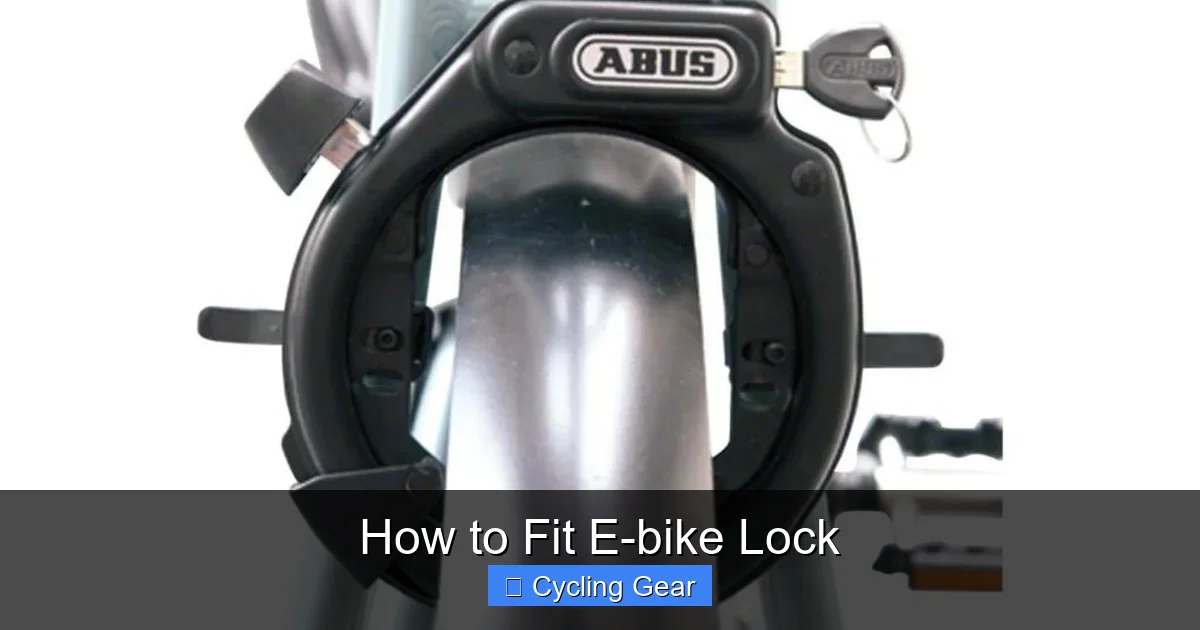
Fit an e-bike lock by choosing a model that matches your frame, then mounting or carrying it where it does not block the battery, motor, or cables. Always test the setup for clearance, rattling, and ease of daily use before relying on it.
Fitting an e-bike lock sounds simple, but electric bikes create a few extra challenges. Frames are often bulkier, batteries may be removable, and motor cables or racks can get in the way if you choose the wrong position.
This guide explains how to fit e-bike lock setups in a way that is practical, secure, and comfortable for everyday riding. The best result is a lock that protects the bike without making it harder to carry, ride, or park.
- Choose first: Match the lock to your frame, battery, and parking habits.
- Mount smart: Keep the lock clear of cables, pedals, and battery access.
- Test fit: Check for rattling, rubbing, and quick-release interference.
- Use better security: Pair the lock with a fixed object when possible.
- Recheck often: Accessories and battery changes can affect fit.
How to Fit an E-bike Lock: What Makes E-bike Security Different in 2026
E-bike security is different because electric bikes are usually more valuable and more attractive to thieves than standard bikes. That means the lock needs to do more than “just fit” the frame. It should also be positioned where it is hard to reach, hard to cut, and unlikely to interfere with the bike’s electronics.
Another difference is weight and shape. Many e-bikes have wider down tubes, integrated batteries, rear racks, or unusual frame lines. A lock that works on a regular commuter bike may feel awkward on an e-bike unless you check the available space first.
Lock fit depends on the exact bike model, battery design, and accessories. Always check the product manual or ask a qualified professional if you are unsure about frame compatibility or mounting points.
Choosing the Right Lock Before You Fit It to Your E-bike
The right lock is easier to fit and more likely to be used every day. Before buying, think about the frame shape, where you park, and whether you want the lock mounted on the bike or carried separately.
For many riders, the best choice is the one that balances security, weight, and convenience. A very heavy lock may offer strong protection, but if it is annoying to carry, you may stop using it consistently.
D-lock vs chain lock vs folding lock for e-bike frames and batteries
D-locks, chain locks, and folding locks each fit e-bikes differently. A D-lock is compact and usually strong, but it can be awkward if your frame or wheel clearance is tight. A chain lock is easier to wrap around posts and racks, but it is heavier and often bulkier to carry.
Folding locks sit somewhere in the middle. They are usually easier to mount on the frame than a thick chain, but the mounting bracket and folded shape still need enough room. If your e-bike has a removable battery or a very crowded frame area, check whether the lock will block access to charging ports, battery keys, or release levers.
| Option | Best For | Note |
|---|---|---|
| D-lock | Compact frame fit | Strong, but clearance can be tight |
| Chain lock | Flexible parking spots | Heavier and less tidy to mount |
| Folding lock | Balanced daily use | Check bracket fit and folding size |
How frame geometry, wheel size, and battery placement affect fit
Step-through frames, full-suspension e-bikes, and long-tail cargo bikes all create different fitting problems. Wheel size also matters because a smaller frame triangle leaves less room for a lock to pass through the wheel and frame together.
Battery placement is another major factor. If the battery sits on the down tube, a lock mounted there may block removal or make the bike harder to handle. If the battery is integrated into the frame, you may need to mount the lock higher or carry it separately.
Best Lock Mounting Positions on an E-bike
The best mounting position is one that keeps the lock secure, easy to access, and out of the way. It should not rub on cables, hit the crank, or interfere with bottle cages, mudguards, or the battery release.
When possible, test the fit with the bike standing still before you rely on it outdoors. A few minutes of checking can prevent noisy rattling and avoid damage to paint, cables, or components.
Fitting the lock to the frame without blocking the motor, battery, or cables
Try to mount the lock where it sits flat against the frame and does not press on electrical parts. On many e-bikes, the safest area is a section of the main frame tube or a bracket designed by the lock maker.
Avoid placing the lock where it can squeeze wiring or scratch the battery housing. If the lock bracket needs to be tightened hard to stay in place, it may not be the best fit for that frame.
Using the rear triangle, seat tube, or rack area safely
The rear triangle can work well for some riders because it is close to the wheel and often gives a stable place to secure the bike. The seat tube may also be suitable if there is enough room and it does not interfere with seatpost adjustment.
Rack-mounted storage can be convenient on commuter e-bikes, but it should be checked carefully. A rear rack may flex, and some racks are not designed to carry extra lock weight without adding noise or movement.
Step-by-Step: How to Fit an E-bike Lock Correctly
Good fitting is mostly about measuring, testing, and checking for interference. You want the lock to stay secure while riding, but also be easy to remove when you reach your destination.
Check the frame triangle, rear triangle, or mounting area for width, height, and clearance around cables, battery latches, and pedals.
Hold the lock in place before tightening anything. Make sure it can open fully and close without hitting the motor, spokes, or rack.
Attach the mount according to the product manual. If the bracket slips, twists, or blocks another part, try a different position rather than forcing it.
Lift and roll the bike a short distance. Listen for rattling, rubbing, or movement that could get worse on rough roads.
Measuring clearance and checking lock shackle space
For a D-lock or folding lock, the shackle or locking bar needs enough room to pass around the frame and a solid object. If the opening is too small, you may end up locking only the wheel, which is weaker than locking the frame and wheel together.
Measure the space before buying if possible. A lock that is “stronger on paper” is not useful if it cannot fit around your frame and the object you usually lock to.
Securing the lock on the bike vs carrying it while riding
Mounting the lock on the bike is convenient, but it adds weight and can create noise. Carrying the lock in a bag or pannier may be better for some riders, especially if the frame is crowded or the lock is heavy.
If you do mount it on the bike, make sure it does not swing, bounce, or hit the frame. If you carry it, keep the weight balanced so it does not affect steering or comfort.
Testing for rattling, rubbing, and quick-release interference
After fitting, turn the pedals, compress the bike slightly, and move the handlebars through their full range. This helps you see whether the lock touches quick-release levers, cables, mudguards, or the battery cover.
Rattling is more than just annoying. Over time, movement can wear paint and loosen mounts. If the lock is noisy, add the padding or adjust the bracket only if the manual allows it.
Common Mistakes Riders Make When Fitting an E-bike Lock
Many lock problems come from rushing the setup. A lock can be expensive and still perform badly if it is mounted in the wrong place or chosen without checking the bike’s shape.
Mounting the lock where thieves can easily access it
If the lock sits in an exposed, easy-to-reach spot, it may be easier for a thief to attack with tools. Try to position it where the frame blocks direct access, not where it hangs openly on one side.
Also avoid leaving the lock in a place where it can be used as leverage against the frame. The goal is to make the lock hard to grab, hard to cut, and awkward to strike.
Ignoring battery removal, accessories, and mudguard clearance
Many e-bike riders forget that the battery may need to come off for charging or storage. A lock that blocks the battery release can become a daily frustration very quickly.
Accessories matter too. Mudguards, child seats, pannier racks, and frame bags can all change the available space. If your setup changes through the year, recheck the fit before each season.
Choosing a lock that is too short, too heavy, or poorly balanced
A short lock may be secure in theory but too awkward to use in real parking situations. A very heavy lock may be secure but unpleasant to carry, especially on a daily commute.
Poor balance can also make the bike feel lopsided when riding. If the lock is mounted on one side, make sure it does not interfere with pedaling or create a swing that could damage the frame.
Expert Tips for Better E-bike Lock Fit and Security
Once the lock fits properly, the next step is using it in a smarter way. Security improves when the lock, parking location, and bike design all work together.
How to pair the lock with a ground anchor or fixed object
A strong lock is only as useful as the object it is attached to. Whenever possible, pair the lock with a ground anchor, bike stand, or another fixed object that cannot be lifted away easily.
Check that the object is solid and that the lock passes through the frame, not just the wheel. If you cannot lock to a fixed object, consider a different parking spot rather than settling for a weak setup.
Where to position the lock for maximum resistance to cutting tools
Position the lock so it is difficult to reach with bolt cutters or saws. A lock placed low and close to the frame is usually harder to attack than one hanging loosely with lots of open space around it.
Keep the locking area away from the ground if possible. Less space around the lock can make it harder for a thief to use tools with leverage.
When to add a secondary cable or alarmed lock for higher-value e-bikes
For higher-value e-bikes, a second layer of security can make sense. A cable lock may help secure a wheel or accessory, while an alarmed lock can add noise if someone tampers with the bike.
These extras are not a substitute for a strong main lock. They work best as add-ons, especially in busy city parking areas or overnight storage situations. Follow the product manual or ask a qualified professional if you are unsure how to combine different lock types safely.
Cost, Convenience, and Security: What the Best Fit Looks Like
The best fit is rarely the cheapest or the heaviest option. It is the setup that matches your bike, your parking routine, and how much hassle you are willing to accept every day.
Some riders want a simple bracket-mounted lock for quick commuting. Others prefer a heavier chain kept in a bag because they need more flexibility when locking to different objects.
Comparing budget, mid-range, and premium e-bike lock setups
Budget setups may be fine for short stops in lower-risk areas, but they can be less refined in fit and mounting. Mid-range options often offer a better balance of strength, weight, and convenience.
Premium setups usually focus on stronger materials, better brackets, and smoother daily use. Even so, premium does not automatically mean perfect fit, so compatibility still matters more than price alone.
What riders gain by spending more on better fit and materials
Spending more can improve both security and comfort. A better lock may fit the frame more neatly, rattle less, and be easier to carry or mount without blocking other parts.
That said, more money does not solve every problem. If the lock shape is wrong for your frame, even a top-end model may be awkward. Always check the product manual, brand guidance, or a qualified professional when compatibility is unclear.
Final Recap: The Safest Way to Fit an E-bike Lock Without Making Riding Harder
The safest way to fit an e-bike lock is to choose a lock that matches your frame, then mount or carry it in a position that does not block the battery, motor, or cables. After that, test for rubbing, rattling, and access problems before relying on it daily.
For most riders, the best setup is the one that is secure, easy to live with, and realistic to use every time you park. If your bike has unusual geometry or a complicated battery system, check the product manual or ask a qualified professional before final installation.
- Choose a lock that matches your e-bike frame and parking needs.
- Mount it where it does not block the battery, motor, or cables.
- Test for clearance, rattling, and easy daily access.
- Use the lock with a fixed object or anchor whenever possible.
Frequently Asked Questions
What is the best place to fit an e-bike lock on the frame?
The best place is usually a stable frame area that does not block the battery, motor, cables, or pedals. The exact spot depends on your bike model and lock type, so check the product manual or ask a qualified professional if needed.
Should I mount my e-bike lock on the bike or carry it?
Mounting it on the bike is more convenient, but carrying it can work better if the frame is crowded or the lock is heavy. Choose the option that keeps the bike comfortable and the lock easy to use every day.
Can a D-lock fit on any e-bike?
No, not every D-lock fits every e-bike. Frame shape, wheel size, and battery placement can all affect clearance, so it is best to measure before buying.
How do I stop my e-bike lock from rattling?
Check that the bracket is tight, the lock is seated correctly, and nothing is touching cables or accessories. If the rattle continues, try a different mounting position or follow the brand guidance.
Is a chain lock better than a folding lock for e-bikes?
A chain lock offers more flexibility, while a folding lock is often easier to mount neatly on the bike. The better choice depends on your frame space, parking habits, and how much weight you want to carry.
Do I need a second lock for an expensive e-bike?
A second lock can add useful protection, especially in busy or high-risk areas. It is not required for every rider, but it can improve security when used with a strong main lock and a fixed object.