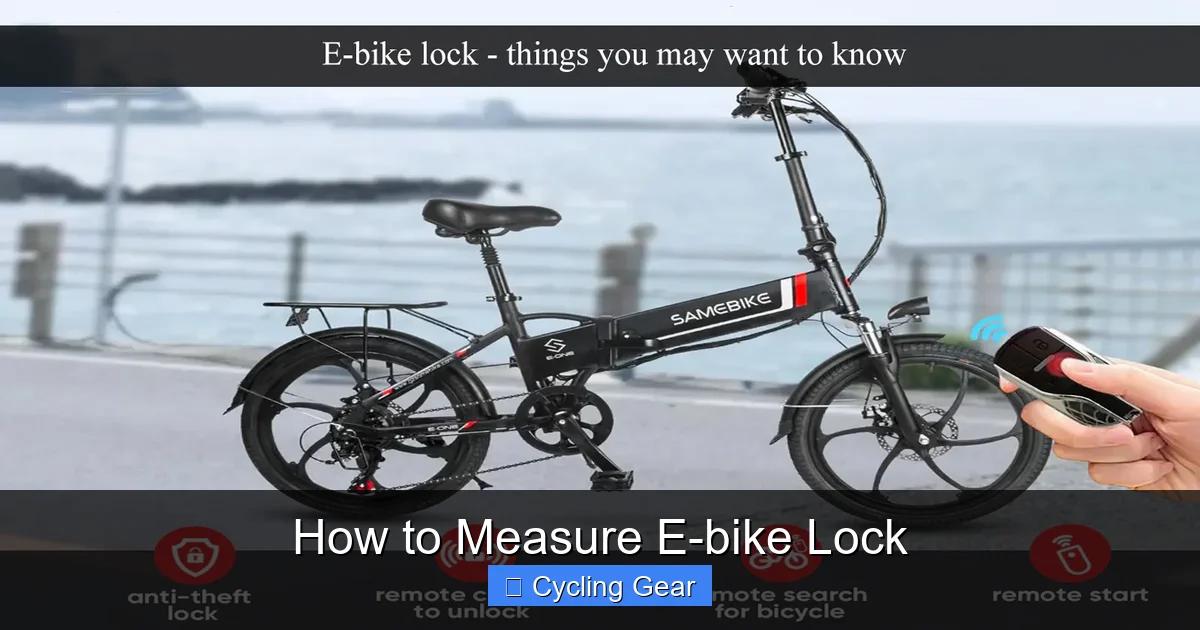
Measure the e-bike, the wheel, and the fixed object together so the lock fits the real parking setup. Choose the smallest lock that still secures the frame and wheel without forcing awkward positioning.
If you’re trying to figure out how to measure e-bike lock fit, the goal is simple: make sure the lock reaches your bike, the anchor point, and any wheels or frame parts you want to secure. E-bikes often need a little more space than standard bikes, so measuring before you buy can save you from a lock that is too short, awkward to use, or easy to defeat.
- Measure the whole setup: Bike plus anchor point, not just the frame.
- Check usable space: Internal clearance matters for U-locks and folding locks.
- Account for accessories: Tires, fenders, racks, and batteries can change fit.
- Match your routine: Commuting and cargo use often need more length.
- Don’t skip security ratings: Dimensions and protection level both matter.
How to Measure an E-bike Lock the Right Way: What Size Actually Matters
When people ask about e-bike lock size, they usually mean one of two things: the physical dimensions of the lock itself and whether that lock can actually wrap around the bike and a fixed object. Both matter. A compact lock may be easy to carry, but if it cannot fit around your frame and rack, it will not do the job.
The most useful measurement is not just the lock’s length on paper. It is the usable clearance once the lock is placed around your e-bike, especially if you have thick tires, a rear rack, fenders, or an integrated battery. Follow the product manual or ask a qualified professional if you are unsure about fit for a specific locking system.
Why E-bike Lock Measurement Is Different from Regular Bike Locks
E-bikes are not always the same shape as regular bicycles. Many have heavier frames, wider tubes, longer wheelbases, and mounted batteries that change the way a lock sits. That means a lock that works fine on a standard commuter bike may feel tight or awkward on an e-bike.
Weight, frame geometry, battery placement, and thicker tubes
Many e-bikes use thicker down tubes or unusual frame shapes to support the motor and battery. Some also have large rear racks or integrated batteries that take up the space where a lock would normally pass through. These design choices can reduce clearance and make certain lock styles harder to use.
Because of that, the lock needs to match the bike’s geometry, not just the wheel size. A chain may be more forgiving, while a short U-lock may require very precise positioning. Check the product manual, brand guidance, or a qualified professional if your frame has unusual mounting points or accessories.
Why “one-size-fits-all” often fails with e-bikes
“One-size-fits-all” is often marketing shorthand, not a guarantee of easy use. A lock might technically fit, but still be too short to secure the frame and wheel to a post in a practical way. That is especially true for cargo e-bikes, step-through frames, and bikes with wide tires.
Lock fit is about real-world reach, not just product claims. A lock that is easy to carry but too small to position correctly can create a false sense of security.
Tools and Measurements You Need Before Buying or Fitting a Lock
You do not need special equipment to measure an e-bike lock setup. A basic tape measure, a note app, and a few minutes in your garage or parking area are usually enough. If you already know your bike’s frame specs from the manufacturer, that can help too.
Frame tube diameter, wheel clearance, and parking-point spacing
Start with the widest points of your bike: the frame tube you plan to lock through, the rear wheel area, and any fenders or racks that may block the lock. Then measure the distance from the bike to the kind of object you normally lock to, such as a rack rail or post.
Parking-point spacing matters because a lock that fits around your frame alone may not fit around the frame plus a public rack. If you commute to different locations, measure for the tightest common setup, not the easiest one.
Measuring with a tape measure vs. using manufacturer specs
A tape measure gives you a real-world number for your current bike and parking spots. Manufacturer specs are useful for frame dimensions, but they do not always account for accessories you added later, like mudguards, child seats, or pannier racks.
Use both when possible. Specs help you understand the bike’s base size, while direct measuring tells you what the lock must actually clear. If the numbers conflict, trust the real-world measurement and check the product manual or a qualified professional before buying.
- Frame tube width at the locking point
- Rear wheel and tire width
- Clearance around fenders, racks, and battery mounts
- Distance to the nearest fixed object
- How much room the lock needs to close securely
Step-by-Step: How to Measure E-bike Lock Fit for Your Bike
The easiest way to measure lock fit is to test the whole setup as one unit: bike, lock, and parking point. That gives you a more accurate picture than measuring the lock alone. It also helps you avoid buying a lock that looks right on paper but is frustrating in practice.
Identify where the lock will pass through the frame. On many e-bikes, this is the seat tube, down tube, or rear triangle, depending on the shape and accessories.
Place the bike near the post, rack, or rail you plan to use. Measure the space needed to include the frame, rear wheel, and the fixed object in one loop or pass-through.
Check the lock’s internal dimensions or total chain length, not just the package size. A lock can look large in photos but still be too short once the ends and locking head are accounted for.
Measuring the frame, rear wheel, and fixed object together
For many riders, the best practice is to lock the frame and rear wheel to a fixed object at the same time. To do that, you need enough reach for the lock to pass through both parts and around the rack or post without forcing the bike into a bad angle.
Measure the widest path the lock must travel. If the bike has a thick tire or a rear hub motor, leave extra room so you are not fighting the lock every time you park.
Checking lock length for U-locks, chain locks, and folding locks
U-locks are usually judged by internal dimensions, so measure the space inside the shackle rather than the outside shape. Chains are easier to size because their total length is usually listed, but the usable length can feel shorter once the lock head is added.
Folding locks sit between the two. They are compact to carry, but the individual links and pivots can reduce the amount of usable space in tight parking spots. If you are unsure, compare the lock’s stated dimensions with a mock setup using rope or a flexible measuring tape.
Testing real-world fit around racks, posts, and urban street furniture
Real-world fit matters more than a perfect number on a spec sheet. A lock that works on a simple round post may fail on a crowded city rack with wide bars, angled supports, or limited access. Try to picture your usual parking spots before you choose a size.
Use a piece of string or soft measuring tape to mimic the lock path before buying. It is a simple way to see whether the lock can actually reach the bike and anchor point without forcing the frame into an awkward position.
Choosing the Right Lock Size for Your Security Needs
Security is not only about thickness or brand reputation. Size affects how you lock the bike, how many parts you can secure at once, and how likely you are to use the lock correctly every day. A lock that is too small often gets used badly, which can reduce protection.
Short vs. long locks: convenience, coverage, and theft risk
Short locks are usually lighter, easier to carry, and less annoying on short trips. The downside is that they can limit your parking choices and may leave the rear wheel or frame exposed if the rack is awkward.
Longer locks offer better coverage and more flexibility, but they can be heavier and harder to store. For commuters, the right balance is usually the smallest lock that still lets you secure the frame and at least one wheel to a fixed object.
- More flexibility at crowded racks
- Easier to secure frame and wheel together
- Better fit for larger e-bike frames
- More weight to carry
- Can be awkward to store
- May cost more in stronger designs
Comparing U-locks, chains, and folding locks by measurement and portability
U-locks are compact and often strong, but their fixed shape makes measurement critical. Chains are the most flexible for fit, especially around odd-shaped e-bikes and street furniture, but they can be bulky. Folding locks aim to balance portability and reach, though their usable space depends on the link design.
| Option | Best For | Note |
|---|---|---|
| U-lock | Short commutes and standard racks | Measure internal clearance carefully |
| Chain lock | Flexible parking and larger frames | Heavier, but easier to position |
| Folding lock | Compact storage with moderate reach | Check usable length, not just folded size |
Cost comparison: compact premium locks vs. larger mid-range options
Compact premium locks often cost more because they use stronger materials or more advanced mechanisms in a smaller package. Larger mid-range options may be less expensive and easier to fit, but they can be heavier and less convenient to carry.
Common Measuring Mistakes E-bike Owners Make
Most lock fit problems come from small oversights, not from bad bikes or bad locks. The good news is that these mistakes are easy to avoid once you know what to look for.
Ignoring thick tires, fenders, racks, and integrated batteries
These features can take up more room than expected. A lock that fits around the bare frame may not fit once you include a fender, battery mount, or cargo rack. Always measure the bike in its fully ridden setup, not just the stripped-down frame.
Measuring only the frame and forgetting the anchoring point
Some riders measure the bike but forget the post, rail, or rack they will actually use. That is a common mistake because the anchor point can be the part that makes the entire setup fail. Measure the whole path the lock must take.
Buying for storage convenience instead of locking flexibility
A lock that folds small or stores neatly on the frame may still be the wrong size for your parking habits. If you often lock in busy city areas or use oversized racks, flexibility matters more than compact storage. Choose the size that supports safe use first, then think about convenience.
Expert Tips and Safety Warnings Before You Buy
Before you spend money, think about where you ride, how long the bike stays parked, and how often you need to lock in different places. Those details matter as much as the lock’s dimensions.
When to size up for commuter use, cargo e-bikes, or oversized frames
Size up if you ride a cargo e-bike, a step-through model with a wide frame, or a bike that regularly parks on unusual street furniture. Commuters who lock up multiple times a day often benefit from a little extra length because it reduces frustration and makes correct locking more likely.
Warning signs that a lock is too small or too easy to position incorrectly
If you have to force the bike into the lock, leave the rear wheel unsecured, or skip the fixed object entirely, the lock is probably too small for your routine. Another warning sign is when the lock can only be closed in one awkward position that leaves too much empty space for thieves to exploit.
A lock that is technically “on the bike” is not always secure. If the fit is tight, unstable, or easy to twist into a weak position, consider a different size or style.
Why certified security ratings matter as much as dimensions
Size alone does not tell you how resistant a lock is to cutting, prying, or picking. Look for recognized security ratings and compare them with your parking risk, especially if you leave the bike outside for long periods. A well-sized lock with poor security can still be a weak choice.
Final Recap: The Best Way to Measure an E-bike Lock for a Secure Fit
The smartest way to measure an e-bike lock is to measure the bike and the parking spot together, then compare that real-world space with the lock’s usable dimensions. That approach is more reliable than choosing a lock based on size labels alone.
For most riders, the best fit is the smallest lock that still secures the frame, at least one wheel, and a fixed object without awkward positioning. If your e-bike has thick tires, racks, a battery mount, or a larger frame, give yourself extra room and check the product manual, brand guidance, or a qualified professional before buying.
- Measure the bike and anchor point together, not separately.
- Check usable lock length or internal clearance, not just package size.
- Account for tires, racks, fenders, and battery placement.
- Choose enough length for secure positioning, then compare security ratings.
Frequently Asked Questions
What should I measure before buying an e-bike lock?
Measure the frame area, rear wheel clearance, and the distance to the fixed object you plan to lock to. Also account for fenders, racks, and battery placement.
Are e-bike locks different from regular bike locks?
Yes, often they are. E-bikes can have thicker tubes, heavier frames, and more accessories, which can change how much lock length or clearance you need.
Should I measure the lock itself or the space around the bike?
Measure both, but focus on the space around the bike and anchor point. The lock must fit the real-world setup, not just the bike alone.
Which lock type is easiest to size for an e-bike?
Chains are usually the easiest to size because they offer more flexibility. U-locks and folding locks can work well too, but their usable space should be checked more carefully.
How do I know if a lock is too small?
If you have to force the bike into position, cannot secure the frame and wheel together, or cannot reach the anchor point comfortably, the lock is likely too small.
Is a bigger lock always better for security?
Not always. Bigger locks can be harder to carry and may be more convenient for thieves to attack in some situations, so size should be balanced with security rating and everyday use.