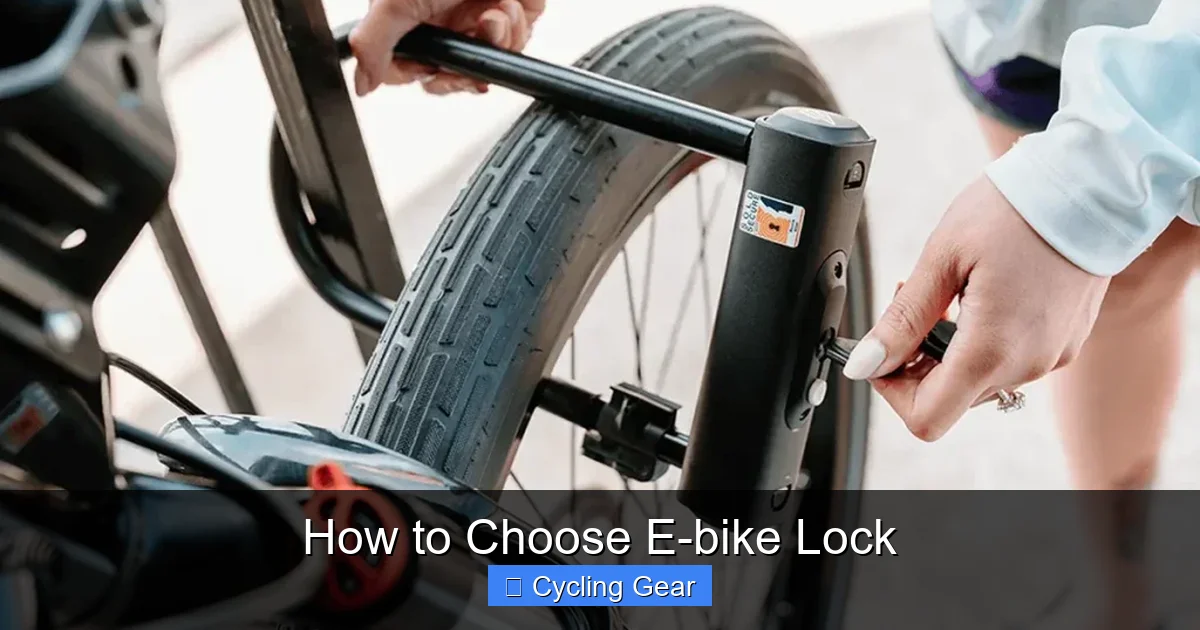
Choose an e-bike lock based on where you park, how long the bike stays unattended, and how valuable the bike is. For most riders, a strong U-lock or chain with a good security rating is a smarter primary choice than a cable lock.
If you are trying to figure out how to choose e-bike lock, the safest answer is simple: match the lock to your real parking risk, not just your budget. E-bikes cost more than regular bikes, attract more attention, and often carry removable parts that thieves can target, so the right lock matters more than ever.
- Match risk: Buy for your most common parking situation.
- Prefer strength: U-locks and chains usually outperform cable locks.
- Check ratings: Look for trusted security standards and solid materials.
- Carry it daily: The best lock is the one you will actually use.
- Layer security: Add alarms, trackers, or a second lock in high-risk areas.
Why E-bike Locks Need a Different Buying Approach in 2026
E-bike security is not the same as standard bike security. A regular commuter bike may be tempting, but an e-bike often looks more valuable at a glance, and that changes how you should shop for protection.
What makes e-bikes more attractive to thieves than standard bikes
E-bikes are often easier to resell because they combine a frame, motor, controller, display, and battery. Even if a thief cannot sell the whole bike, parts can still have value. That means a lock has to do more than slow down a casual grab-and-go theft.
Thieves also know that many riders leave e-bikes in the same spots every day. Predictable parking makes a bike easier to target, especially in busy city areas, near transit stops, or outside workplaces where someone can watch patterns over time.
How battery value, frame value, and resale parts change the risk level
The battery is a major reason e-bikes need stronger security. It can be expensive to replace, easy to remove on many models, and attractive to someone who wants to sell parts separately. A lock should help protect the whole bike, but you should also think about whether the battery can be removed and stored separately.
Frame value matters too, especially on premium models. If your e-bike is expensive enough to hurt your wallet, it is probably expensive enough to attract a thief. In that case, choosing a basic cable lock is usually not enough.
Start with Your Real User Intent: Where, How, and How Long You Park
The best e-bike lock depends on how you use your bike every day. A five-minute coffee stop does not create the same risk as overnight street parking, and your lock choice should reflect that difference.
Commuter parking vs. coffee stops vs. overnight street storage
For short stops, many riders want a lock that is quick to use and easy to carry. For commuting, you may need something stronger because the bike may sit outside for hours. Overnight street storage is the highest-risk situation and usually calls for the strongest lock you can realistically manage, plus extra security steps.
If you only lock up for a few minutes in a low-risk area, portability may matter more. But if you leave your e-bike unattended for long periods, security should win over convenience.
Indoor, garage, campus, and apartment-dwelling use cases
Indoor storage is still worth thinking about because many thefts happen in shared hallways, garages, or apartment bike rooms. A locked garage is safer than a public rack, but it is not automatically secure. Campus parking can also be unpredictable because bikes may be left in the same area for long stretches.
Apartment riders often need a lock that works both outside and inside shared spaces. If you store the bike in a garage or entryway, check the product manual, brand guidance, or a qualified professional if you are unsure about mounting points, anchor compatibility, or wall storage options.
Matching lock strength to your most common parking scenario
Choose for your most common use, not your rarest one. If you usually park in a busy city, buy for city risk. If you mostly store the bike at home but occasionally stop at shops, you may want a mid-weight lock that balances security and daily use.
Think in terms of “most likely theft scenario,” not “worst case only.” A lock you leave at home because it is too heavy offers no protection at all.
The Best Lock Types for E-bikes: Chain, U-Lock, Folding, and Heavy-Duty Cable
Different lock styles solve different problems. The right choice depends on how much security you need, how much weight you can carry, and whether you need flexibility around anchor points.
Why U-locks still lead for security in urban riding
U-locks remain a top choice for urban riders because they are compact, strong, and hard to attack quickly when built well. They are especially useful when you can lock the frame to a solid rack or post with little extra slack.
The downside is fit. A U-lock that is too small may not reach around thicker posts, larger frames, or awkward parking spots. If you buy one, make sure it fits your frame and the places you actually park.
When a chain lock is worth the extra weight
Chain locks can be a smart option when you need more flexibility than a U-lock offers. They are useful for locking to large poles, odd-shaped anchors, or multiple parts of the bike at once. Heavy-duty chains can also be very reassuring for overnight use.
The trade-off is weight. Some chain locks are so heavy that riders stop carrying them, which defeats the purpose. If you choose a chain, make sure you can realistically transport it every day.
Where folding locks fit in for portability and convenience
Folding locks sit between U-locks and chains in many riders’ minds. They are usually easier to pack than a chain and more flexible than a U-lock, which makes them appealing for commuters and apartment riders.
That said, build quality varies a lot. Some folding locks are solid enough for moderate-risk use, while others are better for convenience than serious theft protection. Check the rating, materials, and folding joint quality before buying.
Why cable locks should usually be backup-only
Cable locks are lightweight and easy to carry, but they are usually the weakest choice for an e-bike. They can be cut quickly with basic tools, which makes them a poor primary lock for high-value bikes.
They can still have a place as a secondary lock for accessories, a helmet, or as a short-term backup in a low-risk setting. For the main frame, though, most riders should look higher.
| Option | Best For | Note |
|---|---|---|
| U-lock | Urban commuting | Strong and compact, but fit matters |
| Chain lock | High-risk parking | Very secure, often heavy |
| Folding lock | Portable daily use | Convenient, quality varies |
| Cable lock | Backup use | Usually not enough alone |
Security Ratings, Materials, and Build Quality That Actually Matter
Marketing claims can sound impressive, but ratings and materials tell you more than slogans do. If you want a lock that holds up in real life, focus on proven standards and solid construction.
Understanding Sold Secure, ART, and other common rating systems
Security ratings are helpful because they compare locks using more consistent criteria than brand claims alone. Sold Secure and ART are two names shoppers often see, and both can help you filter out weak options. Higher ratings generally suggest better resistance to attack, though no lock is perfect.
Use the rating as a starting point, not the whole decision. A highly rated lock that is too hard to carry may still fail in practice because you leave it at home. Always balance the rating with your routine and check the product manual or brand guidance for proper use.
Hardened steel, shackle thickness, and anti-cut design features
Look for hardened steel in the shackle, chain links, or locking body. Thicker steel is generally harder to cut, but thickness alone does not tell the full story. The overall design matters too, including how much room a tool has to work and whether the lock shape reduces leverage points.
Some locks also use protective sleeves, double-locking mechanisms, or reinforced crossbars. Those features can improve resistance, but they should be treated as part of a larger security picture rather than a guarantee.
Keyway protection, drill resistance, and anti-pick claims to verify
Many lock listings mention pick resistance or drill resistance. Those features can be useful, but they are easy to overstate in marketing. A protected keyway can help keep out dirt and reduce tampering, while a stronger cylinder may slow down certain attacks.
If a brand makes a bold claim, look for third-party rating support or clear product details. If the information is vague, treat it cautiously and compare it with better-documented options.
No lock is theft-proof. The goal is to make your bike harder, slower, and less appealing to steal than the one next to it.
How to Balance Weight, Portability, and Battery-Powered E-bike Convenience
E-bike riders already carry more than many standard cyclists, especially if the bike is used for commuting. That makes lock weight and storage a real part of the buying decision.
Choosing a lock you will realistically carry every ride
The best lock is the one you actually use. A very heavy chain may look impressive on paper, but if it stays at home because it is annoying to carry, it does not protect your bike. Be honest about how far you ride, what you carry, and whether you want to feel the lock on your back or frame.
If you have shoulder, back, or hand comfort concerns, choose a lock that is easier to handle. If you are unsure what is safe for your body or movement needs, check the product manual, brand guidance, or a qualified professional.
Frame mounts, bags, and storage options for heavier locks
Some locks come with frame mounts or storage brackets, which can make daily use much easier. Others fit better in a pannier, backpack, or basket. The right storage method depends on your bike setup and how much extra gear you already carry.
Before buying, think through the full setup. A lock that fits your bike but not your storage routine may become a hassle. Compatibility can vary by frame shape, battery placement, and accessory mounts.
Trade-offs between ultra-secure locks and daily usability
Ultra-secure locks often cost more, weigh more, and take longer to use. That is normal. The question is whether the added security is worth it for your parking environment.
For many riders, the best answer is a balanced lock with a strong rating rather than the absolute heaviest option. If your bike stays in a low-risk garage, you may not need the same setup as someone parking near a train station every day.
- Better protection for expensive e-bikes
- Less chance of leaving the lock behind
- Easier daily use and transport
- May offer less resistance than heavier options
- Can be too small for some parking spots
- Cheaper models may cut corners on build quality
Common Mistakes Riders Make When Choosing an E-bike Lock
Many lock problems come from buying in a rush. A few simple mistakes can leave even a good e-bike exposed.
Buying for price instead of theft risk
The cheapest lock is not always the best value. If it fails quickly, the real cost can be far higher than the money saved. Price matters, but it should be weighed against the value of the bike and the theft risk in your area.
Locking only the wheel and not the frame or battery area
One of the most common mistakes is securing only a wheel. A thief can remove the wheel and leave with the frame, or simply detach valuable parts. Whenever possible, lock the frame to a fixed object and pay attention to removable components like the battery.
Using a premium e-bike with an underpowered lock
If your e-bike is expensive, a weak lock sends the wrong message. A high-value bike deserves a higher-security lock, especially if it is parked in public often. Think of the lock as part of the bike, not an accessory you can skimp on.
Ignoring anchor points, location risk, and quick-release components
Even a strong lock can fail if it is attached to a weak anchor or used in a poor location. Thin poles, loose racks, and objects that can be lifted out of the ground create problems. Quick-release wheels, seats, and batteries also deserve attention because they can be removed separately.
- Does the lock fit your frame and parking spots?
- Can it secure the frame, not just the wheel?
- Are the anchor points solid and fixed?
- Are removable parts protected or taken with you?
Expert Warning Signs: When a Lock Is Not Enough
Sometimes the parking situation is so risky that a single lock is not the full answer. In those cases, layered security is the smarter approach.
High-risk theft zones and how to respond with layered security
If you regularly park in a theft-heavy area, outside overnight, or in a place with poor lighting and low foot traffic, one lock may not be enough. The more exposed the bike is, the more you should think about stacking protections.
That can mean using two different lock styles, removing the battery, choosing a better parking location, or storing the bike indoors when possible. The goal is to make theft slow, noisy, and inconvenient.
Why a lock should be paired with alarms, GPS trackers, and secure parking habits
A lock is only one part of a larger security plan. Audible alarms can draw attention, GPS trackers may help with recovery, and better parking habits can reduce exposure in the first place. None of these tools replace a strong lock, but together they improve your odds.
Also remember that some tracking devices depend on battery life, signal quality, or app support. Check the product manual, brand guidance, or a qualified professional before relying on any electronic accessory as your main recovery plan.
Situations where you should upgrade to two lock types instead of one
Two locks can make sense if your e-bike is expensive, your parking area is high-risk, or your routine forces you to leave the bike unattended for long periods. A common approach is pairing a U-lock with a chain or folding lock.
This creates more work for a thief and may protect different parts of the bike more effectively. It also gives you more flexibility with awkward racks or larger objects you need to lock around.
Cost, Value, and Final Recommendation Framework
Choosing the right lock is really a value decision. You want enough protection for your e-bike without buying more lock than your routine can support.
How much to spend based on e-bike value and theft exposure
A useful rule is to spend more when the bike is valuable, exposed, or parked in public often. If your e-bike is a major investment, a stronger lock is usually worth the extra cost. If the bike stays indoors most of the time, you may not need the most expensive option.
Costs vary by brand, rating, material, and included accessories, so there is no one-size-fits-all number. Think in terms of protection level and compatibility, not just sticker price.
Comparing budget, mid-range, and premium lock options by protection level
Budget locks may work for very low-risk situations or as backups, but they are rarely ideal as the main lock for a valuable e-bike. Mid-range locks often offer the best balance for everyday riders because they provide stronger materials without becoming too hard to carry.
Premium locks are best for high-risk parking, expensive e-bikes, or riders who regularly leave the bike outside for long periods. The right choice depends on how much risk you face and how much inconvenience you can tolerate.
- Match the lock to your parking risk, not just your bike price.
- U-locks, chains, and folding locks usually beat cable locks for primary security.
- Look for strong ratings, hardened materials, and practical portability.
- For high-risk parking, pair the lock with alarms, trackers, or two-lock setups.
Final recap: the smartest way to choose an e-bike lock in 2026
If you want the simplest answer to how to choose e-bike lock, start with where you park, how long the bike sits unattended, and how valuable the bike is. Then choose the strongest lock you will actually carry and use consistently.
For many riders, that means a well-rated U-lock or chain, with a folding lock as a convenience option and a cable lock used only as backup. If your parking situation is unusual or your setup has special fit concerns, check the product manual, brand guidance, or a qualified professional before buying.
Frequently Asked Questions
What type of lock is best for an e-bike?
A strong U-lock is often the best all-around choice for urban riders, while a heavy-duty chain can be better for higher-risk parking. Folding locks are useful for portability, and cable locks are usually best only as backup protection.
Should I lock the frame or the wheel on an e-bike?
Lock the frame whenever possible, because the frame is the main part you want to protect. If you can, also secure a wheel or remove quick-release parts like the battery or seat.
Are cable locks safe for e-bikes?
Cable locks are usually not secure enough to protect an e-bike by themselves. They can work as a secondary lock for accessories or as a backup in low-risk situations.
What security rating should I look for in an e-bike lock?
Look for recognized third-party ratings such as Sold Secure or ART when possible. A higher rating usually suggests better theft resistance, but you should still choose a lock that fits your daily parking routine.
How much should I spend on an e-bike lock?
Spend based on your bike value and theft exposure rather than picking the cheapest option. A more expensive e-bike usually deserves a stronger lock, especially if you park in public often.
Do I need two locks for my e-bike?
Two locks can be a smart choice for high-risk areas, overnight parking, or expensive e-bikes. Pairing two different lock types can make theft harder and give you more flexibility with parking spots.